
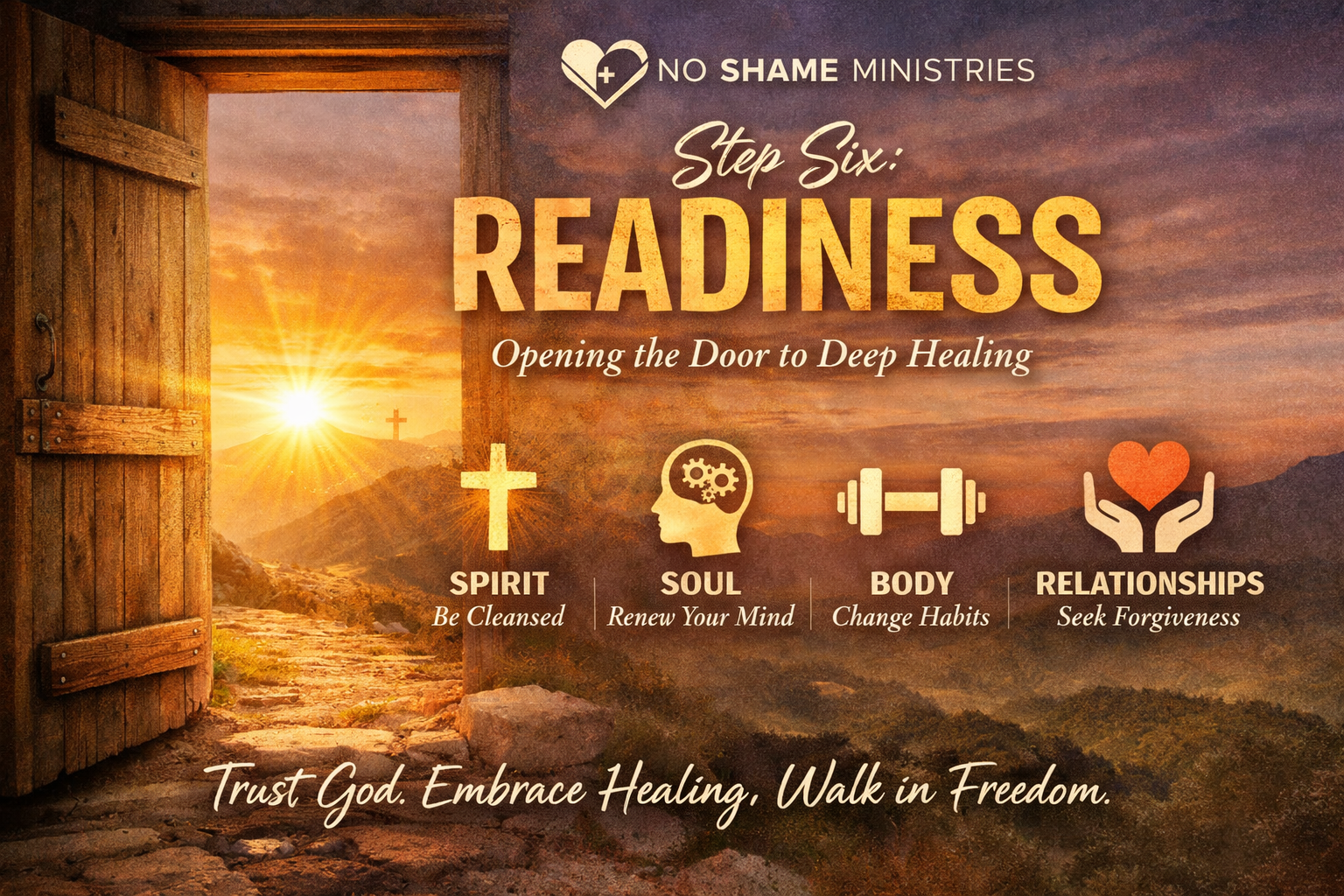
Step Six: Readiness — Opening the Door to Deep Healing
Healing is a journey, not a moment.
By the time individuals arrive at Step Six in the No Shame Ministries process, they have already done courageous work. Step Five invited honest confession — speaking truth aloud, breaking secrecy, and loosening shame’s grip. But confession naturally leads to a deeper question:
Am I truly ready to change?
Step Six is about readiness — becoming entirely willing for God to remove unhealthy patterns and replace them with life-giving coping strategies that lead toward holistic healing.
This step is not about perfection. It is about posture — the posture of the heart that says, “God, I’m willing.”
What Does Readiness Really Mean?
When people hear the word readiness, many emotions surface:
-
Hope
-
Fear
-
Resistance
-
Anticipation
-
Doubt
Why? Because readiness requires release.
It means loosening our grip on patterns that may be destructive — but familiar. Even unhealthy coping strategies can feel safe simply because they are known.
We may ask ourselves:
-
Who will I be without this pattern?
-
Can I survive without this coping mechanism?
-
What if change is harder than staying the same?
These questions are normal. Readiness does not mean the absence of fear — it means willingness in the presence of it.
The Spiritual Foundation of Readiness
Scripture reassures us that transformation is not ours to manufacture alone.
Ezekiel 36:26 reminds us:
“I will give you a new heart and put a new spirit in you; I will remove from you your heart of stone and give you a heart of flesh.”
God is not asking us to perform heart surgery on ourselves. He is the One who replaces hardened places with tenderness.
Likewise, Philippians 1:6 offers assurance:
“He who began a good work in you will carry it on to completion until the day of Christ Jesus.”
Healing is not a self-help project — it is a God-sustained process.
Readiness, then, is rooted in trust:
-
Trust that God sees what we cannot
-
Trust that He heals what we cannot reach
-
Trust that He finishes what He starts
The Core Principle of Step Six
Step Six Statement:
“We became entirely ready for God to remove unhealthy patterns and help us embrace healing and new coping strategies.”
Let’s break this down.
1. “We became entirely ready”
Total readiness can feel intimidating. Many people feel partially ready:
-
Ready to release anger — but not control
-
Ready to surrender anxiety — but not perfectionism
-
Ready to heal wounds — but not forgive offenders
Yet Step Six invites full willingness — not because we feel strong, but because we trust God’s strength.
Barriers often include:
-
Fear of the unknown
-
Comfort in familiar dysfunction
-
Shame about past behaviors
-
Doubt that change will last
Naming these barriers weakens their power.
2. “For God to remove unhealthy patterns”
Transformation is God-driven, not willpower-driven.
If willpower alone worked, long-term healing would be easy. But many unhealthy patterns are trauma-rooted, neurologically reinforced, and emotionally protective.
God addresses what sits beneath behaviors:
-
Core wounds
-
Identity distortions
-
Emotional pain
-
Spiritual disconnection
We partner with Him — but He performs the deep work.
3. “And help us embrace healing and new coping strategies”
Healing is not just subtraction — it is replacement.
God does not simply remove destructive coping tools; He introduces healthy ones, such as:
-
Prayer and grounding practices
-
Emotional regulation skills
-
Counseling and clinical support
-
Community accountability
-
Rest and body stewardship
This integration reflects No Shame Ministries’ commitment to faith + mental wellness + professional care working together.
The Four Dimensions of Healing in Step Six
Readiness impacts the whole person. Step Six invites willingness across four dimensions:
1. Spirit — Spiritual Readiness
This involves openness to God’s cleansing and sanctifying work.
Spiritual readiness may look like:
-
Renewed prayer life
-
Honest surrender
-
Receiving grace instead of earning it
-
Letting God redefine identity
It is the shift from striving to surrender.
2. Soul — Mental & Emotional Readiness
The soul houses thoughts, beliefs, and emotional patterns.
Readiness here includes willingness to release:
-
Negative self-talk
-
Shame narratives
-
Catastrophic thinking
-
Trauma-bonded habits
This often involves therapeutic work alongside spiritual formation — renewing the mind while healing the heart.
3. Body — Physical Readiness
Our bodies store stress, trauma, and coping behaviors.
Physical readiness may involve changing routines such as:
-
Sleep patterns
-
Substance use
-
Nutrition habits
-
Exercise and movement
-
Stress-response behaviors
God cares about embodied healing — not just spiritual healing.
4. Relationships — Relational Readiness
Healing rarely happens in isolation.
This dimension invites openness to:
-
Forgiveness
-
Reconciliation
-
Boundary setting
-
Accountability
-
Safe community
Sometimes readiness means forgiving others. Other times, it means being willing to seek forgiveness.
Both require courage.
Facing the Emotions of Change
Letting go of unhealthy patterns can stir complex emotions:
-
Fear of losing coping mechanisms
-
Grief over time lost
-
Anger at past harm
-
Hope for a new future
All are valid.
Readiness does not silence emotions — it brings them honestly before God.
Many people find freedom simply in admitting:
“Part of me wants to change… and part of me is scared to.”
God meets us in that tension.
Barriers That Block Readiness
Several obstacles commonly resist Step Six work:
-
Fear — of pain, exposure, or failure
-
Shame — believing we are beyond change
-
Pride — resisting help from God or others
-
Doubt — questioning whether healing is possible
Naming these aloud — in groups, counseling, or prayer — reduces their hold.
Silence strengthens barriers.
Honesty weakens them.
Taking the Next Step Toward Readiness
Readiness is both internal and practical.
Consider asking:
-
What area of my life feels most ready for God’s transformation?
-
What unhealthy pattern am I being invited to release?
-
What small step can I take this week to prepare for change?
Small steps matter:
-
Scheduling counseling
-
Practicing a grounding exercise
-
Confiding in a trusted support person
-
Establishing a healthier routine
Preparation creates space for transformation.
A Community of Readiness
One of the most powerful aspects of group recovery is shared courage.
When individuals hear others voice fears and hopes, they often realize:
-
They are not alone
-
Change is possible
-
Healing is happening in real time
Support systems provide:
-
Encouragement
-
Accountability
-
Perspective
-
Prayer covering
Healing accelerates in safe community.
Final Encouragement: Trust the Process
Step Six ultimately centers on trust.
Trust that God can do what we cannot.
Trust that surrender is safer than control.
Trust that healing is worth the discomfort of change.
When we become entirely ready, we open the door for God’s healing power to replace destructive patterns with life-giving ones.
Readiness is not the finish line — it is the doorway.
And on the other side of that doorway is deeper freedom, renewed identity, and integrated healing — spirit, soul, body, and relationships.