
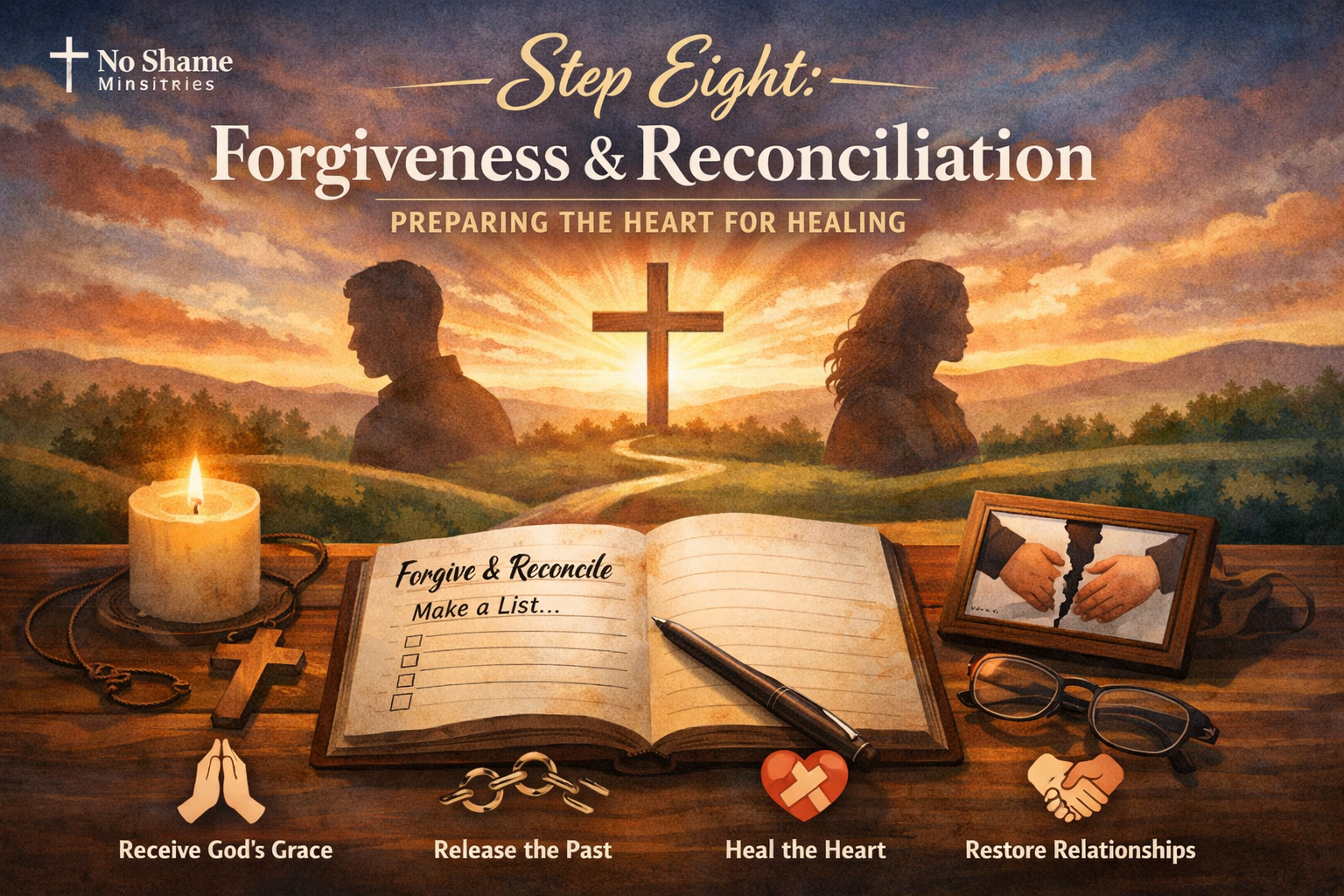
Step Eight: Forgiveness & Reconciliation — Preparing the Heart for Healing
By No Shame Ministries
Forgiveness is one of the most misunderstood and emotionally charged words in the healing journey.
Some hear it and feel relief.
Others hear it and feel resistance.
Many feel both.
In Step Eight of the No Shame Ministries Core Curriculum, we enter a sacred space of preparation — not perfection. This step is not about forcing reconciliation. It is about preparing the heart for it.
As our group lesson reminds us:
“Step Eight is about preparation, not perfection. Today, we’re not fixing everything—we’re simply opening our hearts to God’s forgiveness and beginning to prepare for reconciliation.”
Step 8_Forgiveness_Group_Lesson
The Step Eight Statement
“We made a list of all persons we had harmed, and all who had harmed us, and became willing to extend and receive forgiveness, making amends where possible.”
Step 8_Forgiveness_Group_Lesson
This step moves us from inward transformation to relational courage.
It asks us to do something deeply brave:
-
Name the harm we’ve caused.
-
Acknowledge the harm we’ve received.
-
Become willing to extend and receive forgiveness.
Willingness is the key word.
The Biblical Foundation of Forgiveness
Step Eight is rooted in Scripture:
“Be kind and compassionate to one another, forgiving each other, just as in Christ God forgave you.” — Ephesians 4:31–32
Step 8_Forgiveness_Group_Lesson
“For if you forgive other people when they sin against you, your heavenly Father will also forgive you…” — Matthew 6:14–15
Step 8_Forgiveness_Group_Lesson
Forgiveness is not about minimizing pain.
It is about releasing bitterness.
It is not pretending something didn’t hurt.
It is choosing not to let it define your future.
When we receive God’s forgiveness fully, it becomes possible — though not always easy — to extend it to others.
Why Writing the List Matters
Step Eight begins with something simple but powerful:
“We made a list…”
Step 8_Forgiveness_Group_Lesson
Why write it down?
Because healing becomes real when it moves from vague thoughts to honest acknowledgment.
On that list may be:
-
People we hurt through words or silence.
-
Relationships we damaged through fear, pride, or addiction.
-
People who deeply wounded us.
-
Situations that still trigger resentment or shame.
Writing the list is not about reopening wounds for punishment.
It is about bringing them into the light for healing.
The Four Dimensions of Healing in Step Eight
Step Eight addresses the whole person — spirit, soul, body, and relationships.
1. Spirit — Receiving God’s Forgiveness
Before we can forgive others, we must receive God’s grace.
Many people believe God forgives “in theory,” but struggle to believe He has truly forgiven them.
Step Eight invites us to rest in grace — not earn it.
2. Soul — Releasing Bitterness, Guilt, and Shame
Bitterness poisons the future.
Guilt weighs down the present.
Shame attacks identity.
Forgiveness releases all three.
This is not emotional denial — it is emotional freedom.
3. Body — Letting Go of Physical Stress
Unforgiveness doesn’t just live in the mind.
It often shows up in the body:
-
Tight shoulders
-
Chronic tension
-
Digestive issues
-
Sleeplessness
Resentment creates stress responses that keep the body on alert.
Forgiveness, even in willingness form, begins to calm the nervous system.
Mental wellness and spiritual healing are deeply connected.
4. Relationships — Preparing for Reconciliation
Step Eight is preparation. Step Nine will involve action.
Right now, we are not forcing conversations.
We are becoming willing.
For some, reconciliation will be direct.
For others, boundaries may be necessary.
For some, safety requires working through pain with a counselor before taking any relational steps.
And that is okay.
As our lesson reminds us:
“For some of us, this preparation may include talking with a sponsor, mentor, or a professional counselor who can help us process pain and take healthy steps forward.”
Step 8_Forgiveness_Group_Lesson
Faith and professional support are not opposites. They are partners in healing.
The Hardest Part: Forgiving Ourselves
Many participants in our groups say the same thing:
It’s harder to forgive myself than to forgive others.
Self-forgiveness requires:
-
Accepting that we cannot change the past.
-
Trusting that God’s grace is bigger than our mistakes.
-
Believing we are still worthy of love and restoration.
Shame says, “You are your worst moment.”
Grace says, “You are still becoming.”
Step Eight gently moves us from shame to humility — and from humility to courage.
Moving from Resentment to Willingness
You may not feel ready to forgive today.
That’s okay.
Step Eight does not require emotional resolution.
It asks for willingness.
Willingness sounds like:
-
“God, I’m not ready — but I want to be.”
-
“Help me desire freedom more than revenge.”
-
“Teach me how to release this safely.”
God meets us in our willingness.
And He often uses:
-
Sponsors
-
Small groups
-
Mentors
-
Licensed counselors
-
Trusted community
to walk us through what feels impossible alone.
A Gentle Reflection
As you consider Step Eight, ask yourself:
-
What name or situation comes to mind when you think about forgiveness?
-
Where has resentment shaped your emotions, body, or relationships?
-
What would freedom from that weight feel like?
You are not alone in facing the pain of forgiveness and reconciliation.
Step 8_Forgiveness_Group_Lesson
At No Shame Ministries, we believe healing happens in community — and that stories continue when shame loses its voice.
Closing Encouragement
Step Eight is a bridge.
It connects humility to action.
Grace to courage.
Healing to restoration.
Your story is not defined by who hurt you.
And it is not defined by who you once hurt.
Through faith, mental wellness practices, and professional support when needed, reconciliation becomes possible — not rushed, not forced — but prepared with wisdom and care.
If you’re walking through Step Eight right now, we invite you to:
-
Pray for willingness.
-
Begin your list.
-
Reach out for support.
-
Trust that God works through grace and guidance.
Closing gaps.
Continuing stories.
One step at a time.