
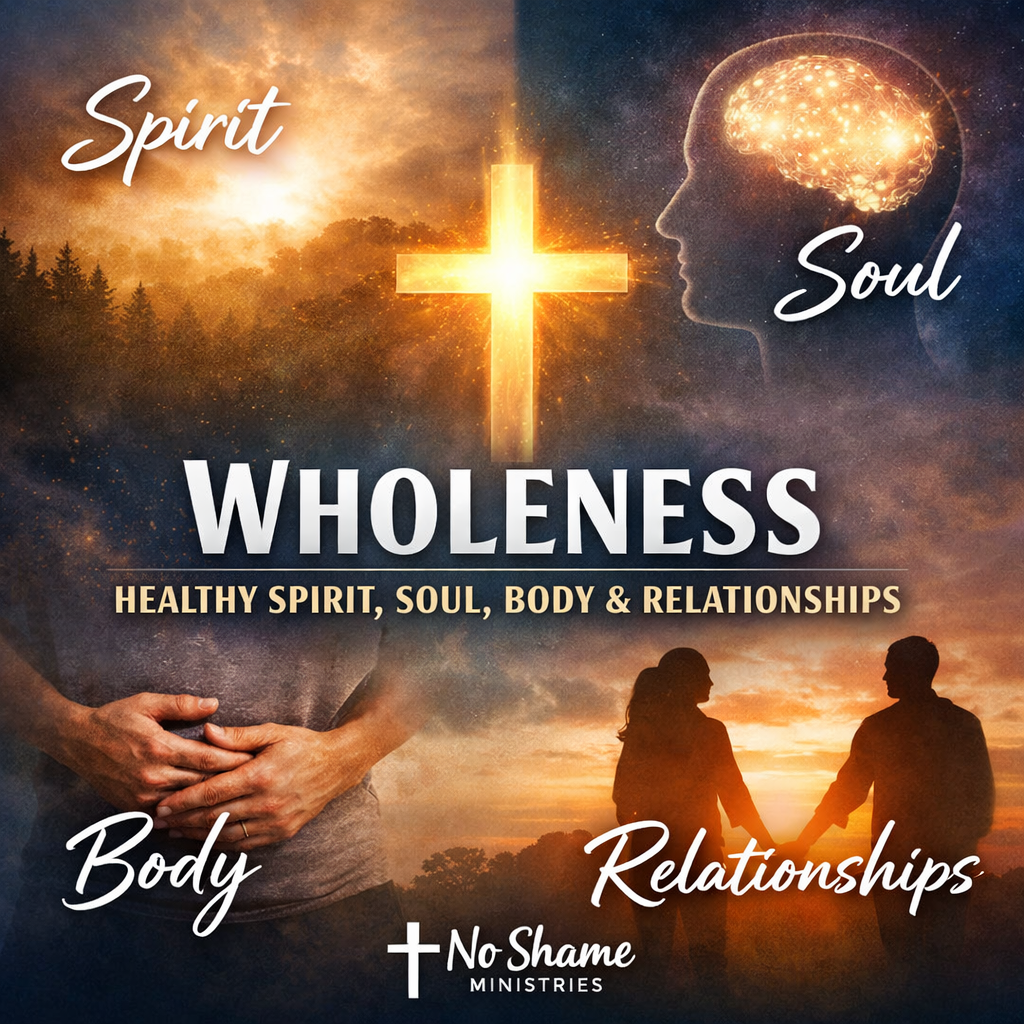
Wholeness: God’s Design for Mental, Spiritual, and Relational Health
Mental health conversations are increasing in churches and communities, but many people still feel unsure how faith and mental wellness fit together.
At No Shame Ministries, we believe God’s design for human flourishing is wholeness — not just spiritual health, but health in spirit, soul, body, and relationships.
Lesson_1__Wholeness_Lesson_1__W…
When one area suffers, the others are affected.
True healing begins when we understand how God designed us and how He restores us.
God Designed Us for Whole-Person Health
When Jesus was asked about the greatest commandment, He answered:
“Love the Lord your God with all your heart, with all your soul, with all your mind, and with all your strength… and love your neighbor as yourself.” (Mark 12:28–31)
Lesson_1__Wholeness_Lesson_1__W…
Notice how holistic this command is.
God calls us to love Him with:
-
Heart
-
Soul
-
Mind
-
Strength
This reflects the reality that humans are not one-dimensional. We are whole beings.
Scripture reinforces this in another passage:
“May the God of peace himself sanctify you completely. May your whole spirit, soul, and body be kept blameless.” (1 Thessalonians 5:23)
Lesson_1__Wholeness_Lesson_1__W…
God’s work of transformation is not partial — it touches every part of who we are.
Understanding the Four Parts of Human Wholeness
To experience healing and growth, we must understand the four core dimensions of our existence.
1. Spirit — Our Connection With God
The spirit is where our relationship with God exists.
Scripture teaches that humanity is born spiritually separated from God but can be made alive through Christ.
Lesson_1__Wholeness_Lesson_1__W…
When we are spiritually alive:
-
Truth becomes clearer
-
God’s presence guides us
-
Our identity begins to heal
Spiritual health is foundational to wholeness.
2. Soul — Our Mind, Will, and Emotions
The soul includes:
-
Thoughts
-
Reasoning
-
Choices
-
Emotions
-
Personality
This is where many mental health struggles occur. When the soul is shaped by lies, fear, or unresolved pain, our perception of reality becomes distorted.
But when truth begins to transform our thinking, healing begins.
This transformation process is what Scripture calls sanctification — the gradual reshaping of our inner life.
3. Body — Our Physical Life
Our bodies are the way our soul and spirit experience the world.
Yet the Bible acknowledges something we all feel:
Our bodies are broken and imperfect.
Physical health, stress, sleep, trauma, and biological factors all influence our mental and emotional well-being.
Lesson_1__Wholeness_Lesson_1__W…
Ignoring the body often prevents real healing.
God cares about our physical health because it affects every other part of our lives.
4. Relationships — We Are Created for Community
God Himself exists in perfect relationship.
Because we are made in His image, we are designed for connection.
But after sin entered the world, relationships became fractured:
-
Blame replaced responsibility
-
Conflict replaced unity
-
Isolation replaced community
Lesson_1__Wholeness_Lesson_1__W…
Healing often requires safe relationships where truth, grace, and accountability exist.
No one heals alone.
Why Does God Allow Pain?
Pain often raises difficult questions.
But pain serves an important purpose.
Pain is often a signal — something is wrong.
Just like physical pain alerts us to injury, emotional and spiritual pain can reveal deeper issues that need attention.
Lesson_1__Wholeness_Lesson_1__W…
Ignoring pain only treats symptoms.
Healing requires identifying the source.
That source may exist in:
-
spiritual disconnection
-
unhealthy thinking patterns
-
physical stress or trauma
-
broken relationships
True healing begins when we honestly examine where the pain originates.
Three Common Responses to Mental Health Struggles
People typically respond to mental health challenges in one of three ways.
1. Denial
Some are taught to simply “push through.”
Statements like:
-
“Just pray more”
-
“Christians shouldn’t struggle”
-
“Have more faith”
often create shame rather than healing.
Denial suppresses pain but never resolves it.
2. Identity Through Diagnosis
Others swing to the opposite extreme.
A diagnosis becomes their entire identity.
Instead of hope, they begin to believe they are permanently broken.
While diagnoses can be helpful for understanding struggles, they should inform care — not define identity.
3. The Path Toward Wholeness
The healthiest path is learning to work through pain.
This involves identifying where struggles originate in the areas of:
-
Spirit
-
Soul
-
Body
-
Relationships
Lesson_1__Wholeness_Lesson_1__W…
Healing often requires a combination of:
-
faith
-
truth
-
community
-
practical mental health tools
-
professional guidance
This integrated approach is central to the mission of No Shame Ministries.
God’s Promise for Healing
Scripture offers a powerful reminder:
“Trust in the Lord with all your heart and lean not on your own understanding… it will bring healing to your flesh and refreshment to your bones.” (Proverbs 3:5–8)
Lesson_1__Wholeness_Lesson_1__W…
Healing may not always be immediate.
But God faithfully works to restore us over time.
Step by step.
Truth by truth.
Relationship by relationship.
The Journey Toward Wholeness
At No Shame Ministries, we believe healing is not about pretending everything is fine.
It’s about courageously addressing the areas where we struggle and inviting God, community, and wise support into the process.
Wholeness means growing toward health in:
-
Spirit
-
Soul
-
Body
-
Relationships
When these areas begin to align with God’s design, people discover something powerful:
Freedom from shame.
And the ability to continue their story.